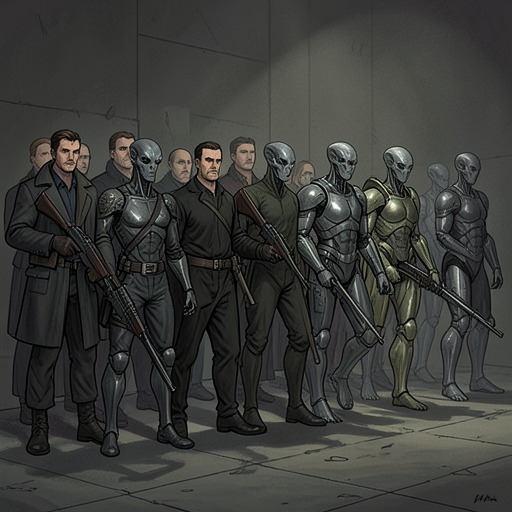
Escape from the Kidnapping Facility
Tinea and Leah: [Cyberpunk, Alien Incursions, Murder and Mayhem, Girl's Love (WLW)]Escape from the Kidnapping Facility is the turning-point action in which Tinea and Leah convert captivity into movement without yet securing safety. Tinea’s escape depends on a mental interface with Protector-grade equipment, Tynea’s point-based tactical guidance, and a rapid shift from stealthy preparation to desperate flight. Freedom arrives not as a secure refuge but as an exposed meteor crater hundreds of kilometers from New Montreal, forcing the pair to choose concealment again when Antithesis danger becomes visible.
Opening the Cocoon
Tinea begins inside a sealed cocoon whose pierce-and-slash resistance makes an ordinary knife useless. The barrier is therefore not merely a physical obstacle but a piece of Protector technology that must be addressed through the same mental systems governing her equipment. By focusing on a mental tab for identifying access points, she brings up a screen displaying two-dimensional models of the samurai-tech items she carries, including the inlay and the membrane. Among the available functions is “Unseal,” and activating it produces a dim line angled around the cocoon. The line matches the orientation in which Tinea believes the cocoon was sealed, suggesting that whoever moved her preserved its position with deliberate care.
The moment makes escape an act of interpretation before it becomes an act of force. Tinea does not overpower the cocoon; she learns to read it as an interface, finds the relevant command, and turns a prison into a mechanism with an access point. The technology’s apparent magic is inseparable from its cost and system logic: liberation is available, but only to someone capable of identifying how the device can be connected to and controlled.
Removing the Door
Once outside the cocoon, Tinea’s enhanced tremor sense reveals the structure of the room and the door beyond it. She can perceive a sturdy lock, as well as iron bars securing the door upward into the ceiling and downward into the floor. The obstacle is consequently too substantial for a quiet manual breach. Tinea asks Tynea for an option, and Tynea recommends a dimensional shunt grenade costing three points. The grenade would remove the door permanently, while quieter alternatives would cost at least seven times as much.
Tinea accepts the noisy-looking risk because the point economy makes the cheaper solution the practical one. Tynea orders her to remain across the room, and the purchase immediately appears as a new grenade in Tinea’s field of vision. The system reports a total cost of three and leaves her with ninety-two points. The weapon’s sudden materialization is both useful and startling: another woman runs past as Tinea reflexively catches it, turning an abstract expenditure into an object in her hand at the exact moment the escape is moving around her.
The grenade is simple enough to operate—pin, trigger, timer dial—but the escape still demands precision. Tinea sets it down, runs silently around the cocoon to the opposite wall, counts off four seconds, and waits through nearly another second before the detonation. Her speed has become an independent resource. She crosses the room in a split second even while deliberately moving slowly for stealth, evidence that the body she is escaping with is already far more capable than the one that entered captivity.
Crossing the Facility
Tinea and Leah proceed through the complex room by room. They pass the guard’s room and creep up the stairwell toward the exit, where the door is already open above the strands of Tinea’s sensory web. Those strings remain still except when disturbed by the pair’s own movements, offering no sign that an attacker or departing vehicle has just passed through. Tinea reaches the landing and finds an empty landing pad rather than an immediate explanation of where the facility’s Antithesis equipment or personnel have gone.
The escape is therefore collaborative rather than solitary. Earlier, Tinea photographs two unidentified women from several angles after Leah says she does not recognize them, hoping to preserve a trail. In the corridor, Tinea gives Leah’s hand a gentle squeeze; Leah returns the hug and buries her nose between Tinea’s antennae with a wry smile. Their physical reassurance does not erase the danger, but it establishes a private continuity inside the hostile facility. The subsequent room-by-room clearance turns that bond into coordinated action: Tinea leads, senses the environment, and handles the technology, while Leah remains beside her as they move toward the open air.
Freedom and Reversal
The breakthrough comes when Tinea finally climbs another stairwell and reaches the outside. She finds freedom, night, and GPS at once, a combination that should make the escape complete. Instead, the navigation system reveals that the facility lies in an old meteor crater roughly seven hundred kilometers northeast of New Montreal. The discovery changes the meaning of the open landing pad. The pair has escaped the building, but not the strategic problem: they are isolated, geographically displaced, and without enough points to move themselves elsewhere.
The result is a sharp reversal in the escape plot. The locked door and cocoon represented immediate confinement; the crater represents freedom without orientation or protection. GPS supplies knowledge rather than rescue. Tinea’s first response is to recognize that she cannot simply spend her way out of the location, because she lacks the points required to move them. The escape thus ends its first phase with mobility achieved but security withheld.
Retreat into Hiding
The outside world proves dangerous almost immediately. Tynea suggests buying a Class 0 satellite uplink so Tinea can learn the condition of Earth, while warning that descending and hiding again may be wiser because Antithesis with very good eyes are nearby. The advice expands the escape from a local breakout into a planetary reconnaissance problem: the captives have left the facility, but they have emerged into a world whose larger condition is unknown and whose enemies may already surround them.
Tinea reacts by snapping up Leah and running from the roof back into the facility. The gesture is protective and decisive, but it also completes the escape’s central paradox. The building that had been a prison becomes temporary cover once the open exterior exposes them to a larger threat. Tinea considers whether to close the door or leave it open, knowing that they need points, cannot yet go anywhere, and cannot afford an assault by the large swarm outside. A few Antithesis probing the building may be manageable; a full attack is not.
The pair therefore ends the action concealed inside the structure they have just fled. Tinea plans to use the building’s underground layout to their advantage: attackers would have to dig in, a process her tremor sense could detect, while the only accessible route leads through the front door, down the stairwell, and past the guard’s room. Escape from the kidnapping facility is consequently not a clean arrival at safety but the establishment of a defensible pause. Tinea and Leah have won access to the night, the landscape, and information, yet survival still requires them to hide, listen, and prepare for the next breach.